Saks Global’s decision to close 15 more department stores signals a deeper transformation happening across the luxury retail landscape.
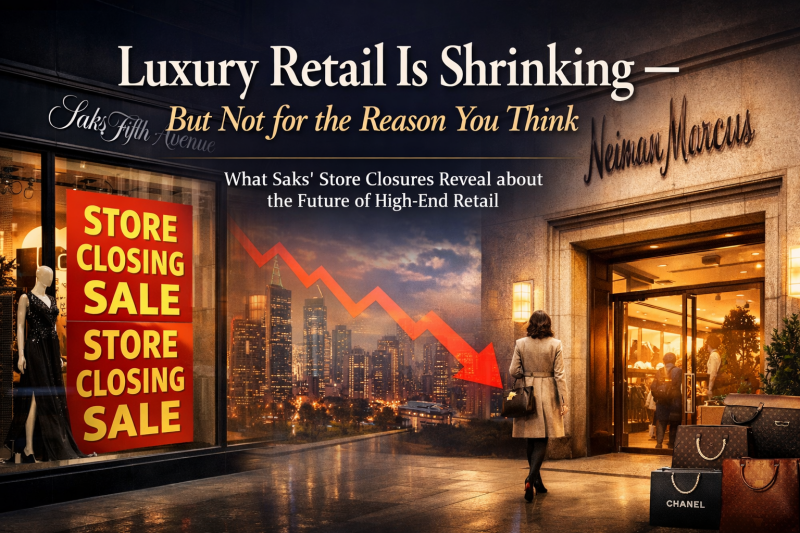
Luxury department stores like Saks Fifth Avenue and Neiman Marcus are facing major strategic changes as the traditional department store model continues to evolve.
Luxury retail has long been associated with prestige, grand storefronts, and iconic department stores located in the world’s most prominent shopping destinations. But the industry is undergoing a quiet but significant shift. Saks Global recently announced plans to close 15 additional department store locations, including several Saks Fifth Avenue and Neiman Marcus stores, as part of its ongoing restructuring efforts.
At first glance, this might look like another example of retail decline. However, the reality is more complex. This move reflects a strategic recalibration of the luxury department store model and highlights broader changes in how luxury brands, retailers, and consumers interact with physical retail spaces.
What Happened
Saks Global announced that it will close 15 department store locations across its portfolio, including multiple Saks Fifth Avenue and Neiman Marcus stores. The closures come during a broader restructuring process following financial pressures and a Chapter 11 bankruptcy filing earlier this year.
The decision is partly tied to the merger and consolidation of Saks and Neiman Marcus operations under Saks Global. In many markets, both brands operated stores within the same malls or shopping districts, creating redundancy in the company’s physical footprint. As a result, Saks Global is now evaluating which locations make the most strategic sense to maintain.
Alongside these closures, the company is also expanding its vendor base by hundreds of brands in an effort to strengthen product assortment and create a more competitive luxury retail offering. This signals that the company is not abandoning physical retail entirely, but rather redefining how its stores operate within the broader luxury ecosystem.
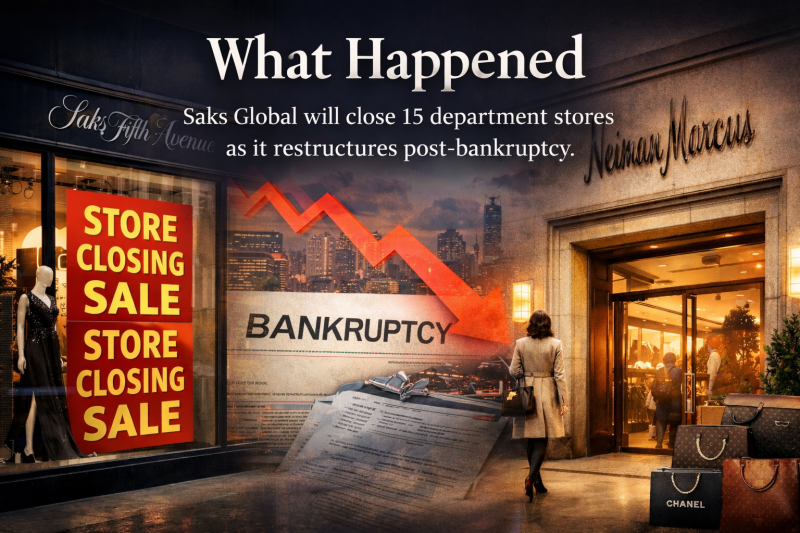
Saks Global announced plans to close 15 department store locations as part of a restructuring effort following financial pressures and overlapping store networks.
Why It Happened
The closures reflect several structural changes that have been reshaping luxury retail for years.
First, the traditional department store model has been under pressure. Luxury brands increasingly prefer to control their own retail experiences through direct-to-consumer channels, flagship stores, and e-commerce platforms. This reduces their reliance on department stores as the primary distribution channel.
Second, the consolidation of Saks and Neiman Marcus created overlapping store networks. In some markets, operating two large luxury department stores within the same shopping center no longer makes financial sense. Rationalizing these locations allows Saks Global to reduce operational costs while focusing resources on stronger, higher-performing stores.
Third, consumer behavior continues to evolve. Luxury shoppers are still visiting stores, but their expectations have changed. They want curated environments, experiential shopping, and unique brand storytelling rather than the traditional department store layout filled with hundreds of racks and brands competing for attention.
Finally, the broader retail landscape has shifted dramatically over the past decade. Rising real estate costs, increased competition from luxury brand boutiques, and the growth of online luxury sales have forced department stores to rethink how many physical locations they truly need.

Luxury department stores are facing pressure from brand-owned retail stores, overlapping physical footprints, and rapidly evolving consumer shopping behavior.
How This Affects Businesses
The ripple effects of these closures will extend beyond Saks Global itself.
Shopping malls and retail real estate owners may feel immediate pressure, particularly if the closing locations served as anchor tenants. Luxury department stores often drive significant foot traffic, and their departure can affect smaller retailers that rely on that traffic.
For luxury brands, the shift could accelerate a trend that is already underway. Many brands may continue expanding their own stores or investing more heavily in direct online sales instead of relying on department store placements.
At the same time, vendors that remain within Saks Global’s ecosystem could benefit from a more focused and curated retail environment. With fewer stores but stronger assortments, the company may be able to concentrate traffic and sales into fewer locations, potentially improving performance per store.
For retailers more broadly, this move reinforces an important lesson. Physical retail is not disappearing, but it is becoming more strategic. Companies are increasingly prioritizing quality of locations over sheer quantity of stores.
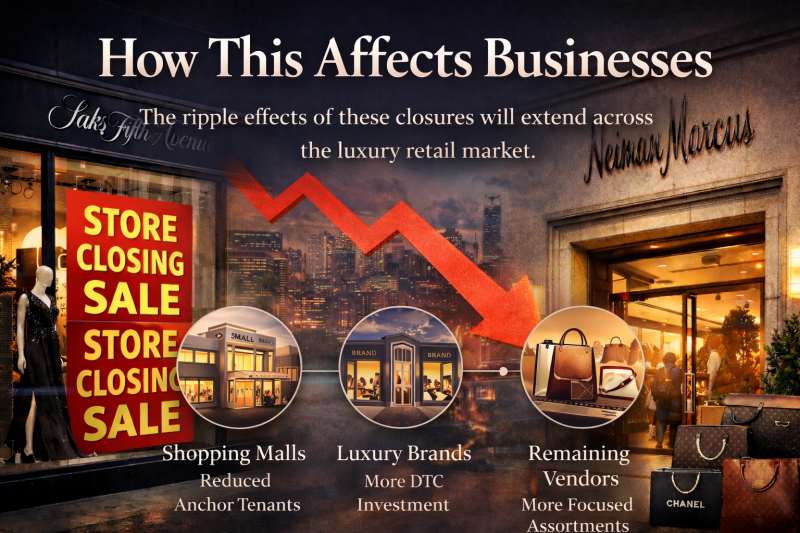
Store closures ripple across the retail ecosystem, affecting shopping malls, luxury brands, and vendors that rely on department stores for distribution.
What Will Happen Next
The future of Saks Global will likely revolve around a smaller but more strategically positioned store network. Instead of maintaining a large number of locations, the company may focus on flagship stores and high-performing markets where luxury demand remains strong.
At the same time, expect continued investment in digital infrastructure and omnichannel retail strategies. The luxury shopping journey now moves fluidly between online discovery and in-store experiences, and retailers must support both environments seamlessly.
This consolidation may also signal a broader trend across the luxury department store sector. Other retailers could follow similar strategies, reduce store counts while invest in experiential retail concepts designed to attract high-value customers.
In many ways, the department store is evolving rather than disappearing. The stores that remain will likely look very different from the traditional format that dominated luxury retail for decades.
Final Thoughts
The closure of 15 Saks Global department stores is not simply a story about decline. It is a reflection of an industry adapting to new consumer behaviors, new competitive pressures, and new retail strategies.
Luxury retail is shifting toward fewer but stronger physical locations supported by powerful digital ecosystems and brand-driven experiences. Retailers that recognize this shift and adapt their store strategies accordingly will be far better positioned for the future.
For consultants, retailers, and brand operators, the key takeaway is clear: success in modern retail is no longer about how many stores you operate. It is about how effectively each store contributes to the broader customer experience.
About the Author
Christian DiBuono is a retail merchandising consultant specializing in store layout optimization, planogram strategy, and retail execution analysis. Through his work with retailers and brands, he helps businesses improve product placement, customer flow, and in-store performance using practical merchandising frameworks.
If your retail store is struggling with product placement, store layout, or merchandising strategy, small changes can often unlock major improvements in performance.
Explore my retail merchandising services on Fiverr to see how I help retailers improve shelf strategy, store layouts, and in-store execution.
Add comment
Comments