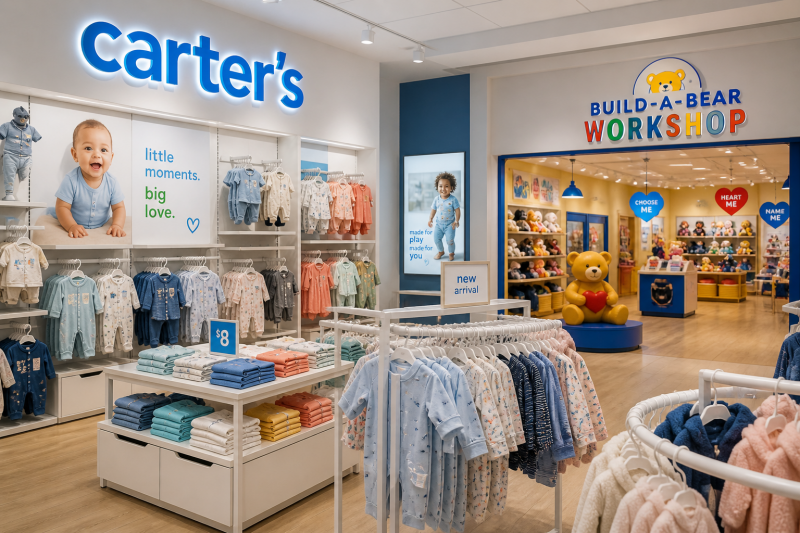
The children’s retail space just made a quiet but significant move. Carter’s has appointed Sharon Price John—best known for leading Build-A-Bear Workshop through a major turnaround—as its new CEO. On the surface, this looks like a standard leadership change. In reality, it’s a signal of where retail is heading next.
Carter’s isn’t just hiring a CEO. It’s hiring a playbook.
John spent over a decade transforming Build-A-Bear from a mall-dependent novelty retailer into a modern, omnichannel brand with strong emotional positioning. She expanded the business beyond traditional stores, leaned into e-commerce, tapped into collectors and gifting markets, and used storytelling and intellectual property to drive demand. (Retail Dive) What Carter’s is really buying is that transformation mindset.
That matters because Carter’s is at a crossroads.
The company has already been going through restructuring efforts—closing stores, streamlining operations, and trying to navigate tariffs and margin pressure. (Retail TouchPoints) At the same time, leadership turnover has been abrupt. The previous CEO lasted barely a year, and analysts called the transition “a surprise.” (Retail Dive) That kind of instability usually points to deeper strategic uncertainty.
So this hire isn’t about maintaining the business. It’s about redefining it.
The real question is: what does a Build-A-Bear-style strategy look like inside a baby apparel giant?
It starts with moving beyond product-first retail.
Build-A-Bear succeeded because it sold an experience, not just merchandise. Customers didn’t go there for stuffed animals—they went for interaction, personalization, and emotional connection. Carter’s, historically, has been much more transactional: reliable basics, value pricing, and broad distribution. That model still works, but it doesn’t differentiate in today’s retail environment.
Expect that to change.
John’s track record suggests Carter’s will lean more into brand storytelling, lifecycle marketing, and emotional positioning around parenthood milestones. Carter’s already has a built-in advantage here—parents associate the brand with “first moments” in a child’s life. The opportunity is turning that emotional equity into a stronger conversion engine.
The second shift is omnichannel execution—not just presence.
E-commerce growth alone isn’t enough anymore. What made Build-A-Bear’s approach effective was integration: physical stores, digital engagement, and content working together. Under John, Carter’s is likely to move toward a more connected ecosystem where stores aren’t just fulfillment points, but experience hubs that reinforce the brand.
This becomes especially important as foot traffic patterns continue to change.
The third shift is category expansion without losing focus.
One of John’s biggest wins at Build-A-Bear was expanding into adjacent revenue streams—gifting, collectors, and partnerships—without diluting the core brand. Carter’s has a similar opportunity. Beyond apparel, there’s room in accessories, bundled gifting solutions, and even experience-driven retail concepts tied to early childhood moments.
But here’s the catch.
What worked at Build-A-Bear won’t automatically translate.
Carter’s operates at a completely different scale, with over 1,000 stores and a mass-market positioning. (Retail TouchPoints) It’s less about novelty and more about consistency. The challenge will be balancing operational efficiency with brand elevation—without alienating price-sensitive customers.
That tension will define whether this move succeeds.
From a retail strategy perspective, this leadership change highlights a bigger industry trend: companies are no longer just looking for operators. They’re looking for transformation leaders—executives who can rebuild relevance in a market where consumer expectations have fundamentally changed.
Carter’s didn’t just hire a CEO from another retailer.
It hired someone who understands how to turn a product into a story, a store into an experience, and a brand into something people actively choose—not just default to.
And in today’s retail environment, that difference is everything.
Add comment
Comments