How decades-old legal agreements are slowing mall redevelopment — and why Simon Property Group’s move could reshape retail real estate.

Mall redevelopment has often been limited by legal agreements between landlords and anchor tenants.
In retail, the biggest obstacles to change are not always declining sales or shifting consumer habits. Sometimes the biggest barriers are buried deep inside legal agreements written decades ago. A recent development involving Simon Property Group and Saks Global highlights how these overlooked legal structures have quietly shaped the evolution of American malls for years.
While most shoppers never think about the legal relationships between mall operators and department stores, those agreements have often determined what landlords can and cannot do with their own properties. Now, one of the largest mall operators in the United States may finally have a path to break free from those restrictions.
What Happened
Simon Property Group, the largest mall owner in the United States, recently secured the ability to bypass certain restrictions that historically limited what it could do with many of its mall properties. These restrictions stem from something known as reciprocal easement agreements, commonly referred to as REAs. For decades, these agreements gave anchor department stores significant influence over mall development decisions.
In many cases, mall operators were required to obtain approval from anchor tenants before making changes to their properties. That could include renovations, changes in tenant mix, redevelopment projects, or even relatively small alterations to the layout of the mall. While the agreements were designed to protect the interests of large department stores, they often slowed down the ability of landlords to adapt to changing retail conditions.
Simon Property Group managed to remove these restrictions at nearly sixty of its properties through a deal connected to Saks Global. When Saks Global acquired Neiman Marcus in 2024, Simon invested $100 million in the company. As part of that investment, Simon negotiated the ability to bypass certain redevelopment restrictions tied to Saks and related stores located within its malls.
Although Saks Global later entered Chapter 11 bankruptcy after the debt-heavy acquisition, Simon appears to have gained something potentially more valuable than the investment itself: far greater control over how its mall properties can evolve.
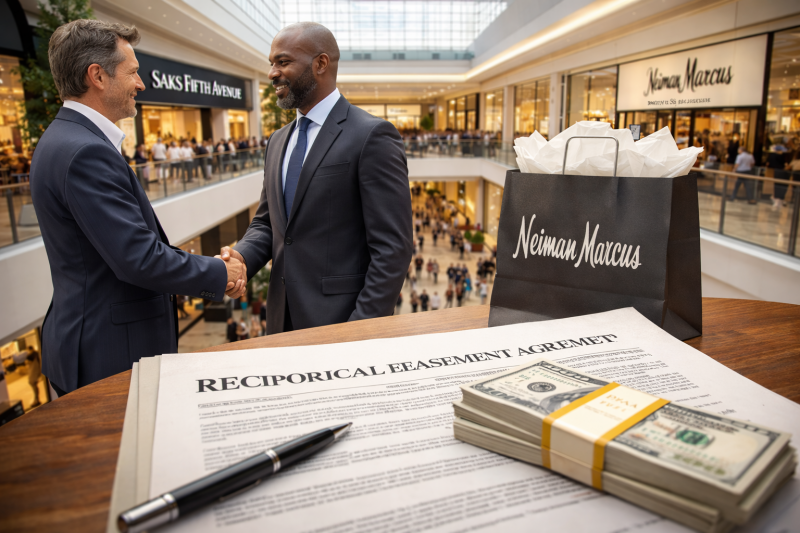
Simon Property Group negotiated new terms with Saks Global, allowing greater redevelopment flexibility.
Why It Happened
To understand why these agreements existed in the first place, it helps to look back at how shopping malls were originally developed. In the mid-twentieth century, department stores were the primary drivers of mall traffic. They served as the anchors that brought shoppers into the building, and smaller retailers depended heavily on that traffic to survive.
Because of this dynamic, mall landlords often made significant concessions to secure department store tenants. Reciprocal easement agreements were one of those concessions. These agreements allowed anchor tenants to protect their interests by ensuring that major changes to the mall would not negatively impact their business.
At the time, this structure made perfect sense. Department stores held enormous power in the retail ecosystem, and landlords were willing to sacrifice some control in exchange for stability and foot traffic.
However, retail has changed dramatically over the past two decades. Many department store chains have struggled, closed locations, or significantly reduced their physical footprint. Meanwhile, mall operators have increasingly looked for ways to reinvent their properties by adding entertainment venues, restaurants, apartments, offices, and other mixed-use developments.
The problem is that many of those decades-old legal agreements remained in place even as the retail landscape evolved. As a result, landlords sometimes found themselves unable to move forward with redevelopment plans without approval from anchor tenants whose influence had diminished significantly.
Simon’s deal with Saks Global provided a rare opportunity to unwind part of that legacy structure.

Removing redevelopment restrictions could accelerate the transformation of traditional malls into mixed-use destinations.
What Will Happen as a Result
With fewer restrictions tied to anchor tenant approvals, Simon Property Group now has significantly more flexibility to transform its properties. This flexibility could accelerate the ongoing shift in how malls are developed and managed across the United States.
Many mall operators are already working to convert traditional retail centers into broader mixed-use destinations. Instead of relying solely on retail stores, modern malls increasingly incorporate residential buildings, hotels, offices, medical spaces, entertainment venues, and experiential retail concepts. These changes help keep properties relevant in a retail environment where online shopping has permanently altered consumer behavior.
The ability to redevelop spaces without navigating complicated approval processes from anchor tenants could allow Simon to move much faster on these projects. Vacant department store spaces, in particular, represent enormous redevelopment opportunities. Large anchor footprints can be converted into residential units, entertainment complexes, fitness centers, or even entirely new retail concepts that better reflect modern consumer preferences.
Simon’s move could also influence other mall operators to pursue similar negotiations with department store chains. If more landlords find ways to restructure or eliminate these long-standing agreements, it could lead to a broader wave of mall redevelopment across the country.
Final Thoughts
This situation highlights an important lesson about the retail industry: sometimes the biggest obstacles to innovation are not market trends or consumer behavior, but legacy systems that were built for a completely different era.
Reciprocal easement agreements were once a logical way to protect the relationship between malls and department stores. But as retail has evolved, those same agreements have occasionally become barriers to progress.
By regaining greater control over its properties, Simon Property Group may have positioned itself to adapt faster than many competitors. And in a retail landscape that is constantly changing, the ability to move quickly and reshape physical spaces may ultimately become one of the most valuable advantages a mall operator can have.
About the Author
Christian DiBuono is a retail merchandising consultant who analyzes retail strategy, store execution, and industry trends. His work focuses on how retailers can improve store performance through better merchandising, layout planning, and retail execution.
Add comment
Comments