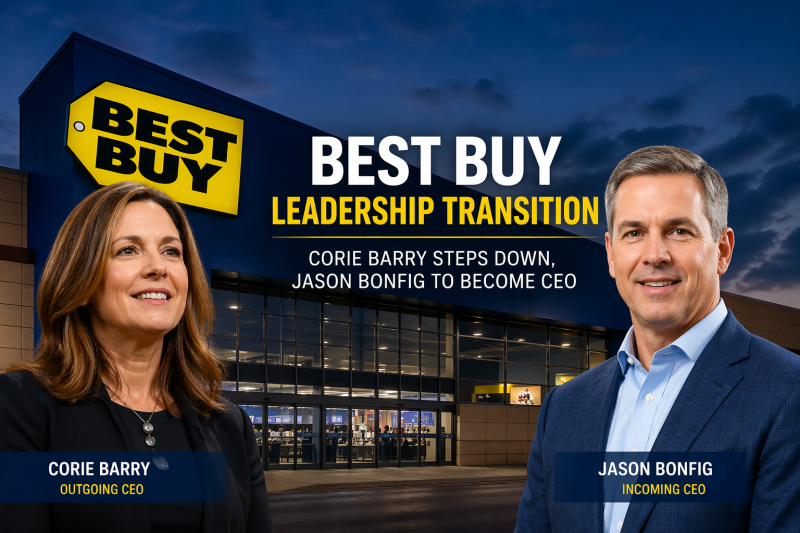
The recent announcement that Corie Barry will step down as CEO of Best Buy, with longtime executive Jason Bonfig taking over, isn’t just a leadership story. It’s a signal of where modern retail is heading—and where it’s struggling to keep up.
Barry, who became CEO in 2019, led the company through one of the most volatile periods in retail history, including the pandemic-driven surge in electronics demand and the sharp slowdown that followed. But despite stabilizing the business, Best Buy has faced declining sales in most recent quarters and ongoing pressure from shifting consumer behavior.
This transition isn’t about replacing leadership. It’s about resetting direction.
The Reality Behind the Transition: Retail Isn’t Growing the Same Way Anymore
Best Buy’s situation reflects a broader issue across retail: the demand curve has fundamentally changed.
During the pandemic, electronics retailers benefited from forced upgrades. People needed laptops, home office setups, and entertainment systems. That demand spike created an artificial high. Now, the market has normalized, and consumers are more selective, delaying purchases of big-ticket items due to inflation and higher borrowing costs.
That’s where leadership matters most.
When growth stalls, retailers don’t just need operators—they need repositioning strategies. The fact that Best Buy chose an internal candidate like Bonfig suggests the company isn’t looking to reinvent itself entirely, but rather double down on areas already in motion: digital expansion, services, and retail media.
Why Jason Bonfig’s Appointment Matters More Than It Seems
At first glance, promoting from within might seem like a “safe” move. But Bonfig’s background tells a different story.
He’s been leading customer experience, product strategy, fulfillment, and key digital initiatives—including Best Buy’s online marketplace and advertising business.
That’s not accidental.
Retail is shifting away from pure product sales into ecosystems. The winners today aren’t just selling inventory—they’re monetizing traffic, data, and services. Think about what Amazon did with ads, or how Walmart is building retail media. Best Buy is trying to play that same game.
Bonfig represents that shift.

The Bigger Retail Lesson: Stores Alone Don’t Drive Growth Anymore
What this leadership change really highlights is something most retailers still haven’t fully accepted.
Physical stores are no longer the primary growth engine.
They’re part of a larger system that includes e-commerce, fulfillment, media, and services. Best Buy already operates over 1,000 stores, but store count isn’t the problem. The challenge is how those stores connect to the rest of the business.
That’s why you’re seeing moves like expanding marketplaces, investing in AI-driven shopping experiences, and building advertising platforms.
Retail isn’t about selling products anymore.
It’s about owning the customer journey.

The Pressure Ahead: Why This Transition Isn’t Guaranteed Success
Even with the right strategy, execution is where most retailers fail.
Best Buy’s sales have declined in the majority of recent quarters, and its stock performance has lagged behind the broader market. That’s not just a macro issue—it’s a signal that the company hasn’t fully translated its strategy into consistent growth.
Bonfig now inherits a business that needs to do three things at once: stabilize demand, modernize its model, and compete with companies that are already ahead in digital ecosystems.
That’s a difficult balance.
And in retail, execution gaps show up fast—especially on the sales floor, where strategy meets reality.
What Retailers Should Actually Take Away From This
This isn’t just about Best Buy.
It’s a case study in what happens when a retailer hits the ceiling of its current model.
Leadership changes like this usually mean one thing: the company is trying to move from one phase of retail to another. From transactional to experiential. From product-focused to ecosystem-driven. From store-first to customer-journey-first.
Most retailers say they’re doing this.
Very few actually are.
Final Thought: Leadership Changes Don’t Fix Retail—Execution Does
A new CEO won’t fix declining sales on its own. Strategy decks don’t improve conversion. And digital investments don’t matter if the in-store experience doesn’t support them.
What matters is how all of it connects.
Best Buy’s next chapter will depend on whether it can align its stores, digital platforms, and customer experience into one cohesive system. If it does, this leadership transition will look like a turning point.
If it doesn’t, it will just look like another change at the top.
And in retail, that’s the difference between adapting—and falling behind.
Add comment
Comments