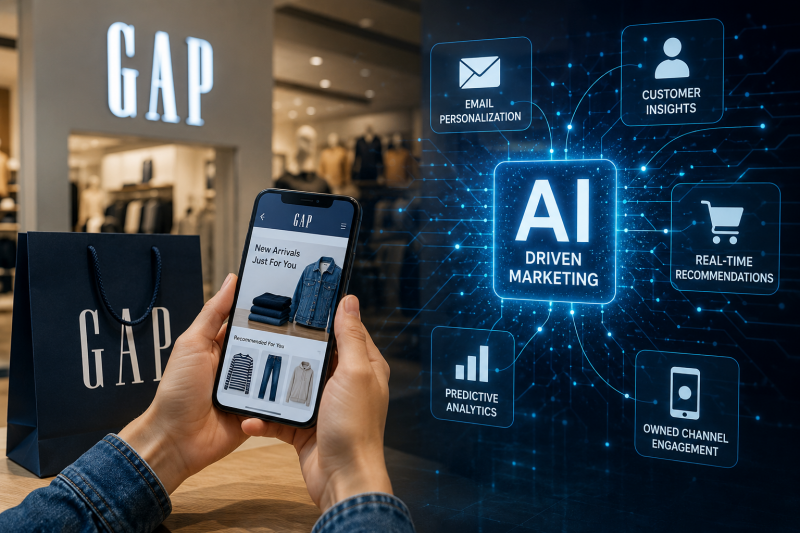
Artificial intelligence has become one of the biggest topics in retail, with companies investing heavily in tools that improve forecasting, inventory management, and customer service. Now, Gap Inc. is taking its AI strategy a step further by using the technology to reshape how it connects with customers through its own marketing channels.
The apparel retailer recently announced a major initiative focused on modernizing its marketing organization with artificial intelligence, data integration, and automation. Rather than treating marketing as a series of disconnected campaigns, Gap’s goal is to create a more unified system that can better understand customer behavior and deliver more personalized experiences across its brands.
This move reflects a broader shift occurring throughout the retail industry. For years, retailers collected massive amounts of customer data but often struggled to turn that information into meaningful actions. Marketing teams frequently worked with fragmented systems, making it difficult to deliver consistent messaging across websites, email campaigns, loyalty programs, and digital shopping experiences. AI is now giving retailers an opportunity to bridge those gaps and create a more connected customer journey.
Gap’s approach focuses on leveraging AI to improve customer engagement through its owned channels. By combining customer data with predictive technology, the company hopes to better understand what shoppers want, when they want it, and how they prefer to interact with the brand. The result could be more relevant product recommendations, more personalized marketing messages, and stronger customer relationships over time.
The company is partnering with major technology providers to support the initiative, creating a foundation that brings together customer and product information into a single ecosystem. This allows AI systems to identify patterns, generate insights, and help marketers make faster and more informed decisions. Instead of relying solely on historical performance, teams can react to customer behavior in real time and adjust their strategies accordingly.
What makes this development particularly interesting is that it highlights how AI is evolving within retail. Early adoption focused largely on operational efficiencies such as inventory forecasting and supply chain optimization. While those applications remain important, retailers are increasingly recognizing that AI can also play a critical role in driving customer engagement and loyalty. Marketing is becoming one of the next major battlegrounds for AI innovation.
For retailers of all sizes, Gap’s strategy serves as a reminder that technology alone is not the solution. Success depends on having reliable data, clear objectives, and a customer-centric approach. AI can help organizations move faster and make better decisions, but its effectiveness ultimately depends on how well it is integrated into the overall customer experience.
As consumer expectations continue to rise, personalization is becoming less of a competitive advantage and more of a requirement. Shoppers expect brands to understand their preferences and provide relevant experiences at every touchpoint. Retailers that can successfully combine AI, data, and marketing execution will be better positioned to meet those expectations and build lasting customer relationships.
Gap’s latest initiative demonstrates that the future of retail marketing is becoming increasingly intelligent, connected, and data-driven. While the long-term results remain to be seen, the company’s investment signals where much of the industry may be headed next. AI is no longer just improving retail operations behind the scenes—it is beginning to redefine how brands communicate with the customers they serve.
Add comment
Comments