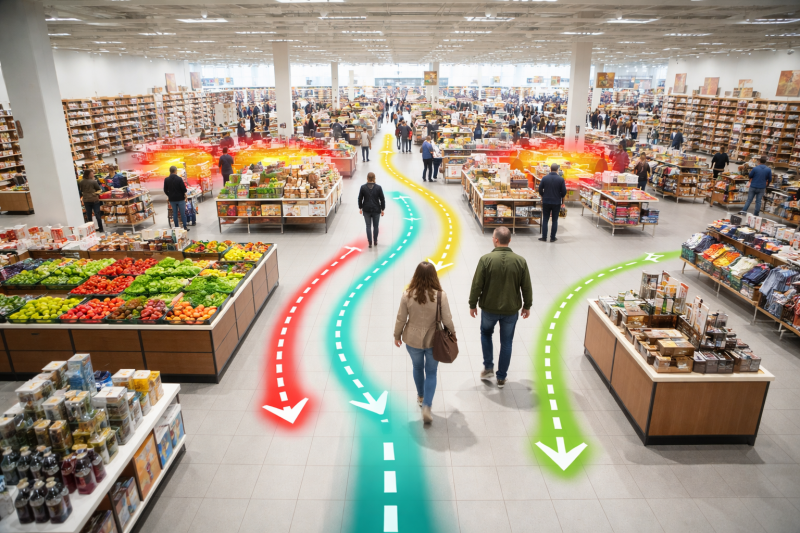
The Hidden Problem in Retail Store Layouts
Walk into almost any retail store and you’ll notice something familiar. Shelves are organized neatly, promotional displays are placed at the ends of aisles, and signage is positioned exactly where the planogram suggests it should be. Everything looks intentional and structured.
However, there is a major flaw in how many stores are designed.
Most retailers build their layouts based on where they think customers stop rather than where customers actually stop.
This misunderstanding creates one of the biggest hidden problems in retail execution. Products are placed in locations that seem logical from a merchandising standpoint but do not align with real customer behavior. When this happens, displays fail to capture attention, promotional space gets wasted, and valuable sales opportunities are missed.
Understanding where customers naturally pause, slow down, or shift their attention inside a store can significantly improve merchandising performance and product visibility.
The problem is that most stores are built around assumptions instead of observation.
The Assumption: Displays Automatically Capture Attention
Retail planning often assumes that customers will stop when a display is placed in front of them. Endcaps are expected to capture attention automatically, promotional tables are expected to interrupt customer movement, and checkout displays are expected to trigger impulse purchases.
Sometimes these strategies work, but many times they do not.
The reason is simple. Customer movement inside a store follows behavioral patterns, not merchandising plans.
When shoppers enter a store, they do not immediately begin examining products. Instead, they go through a brief adjustment period where they take in the environment around them. Lighting, sound, store layout, and the overall visual atmosphere all influence how customers orient themselves.
During this moment, their focus is not yet on buying or browsing.
The Decompression Zone
This area is known in retail design as the decompression zone.
The decompression zone typically exists within the first several feet inside the entrance of a store. Many retailers place important promotional displays here because it appears to be a high-traffic location. In reality, customers are still adjusting to the space and often walk directly past these displays without processing them.
This is one of the most misunderstood areas in retail layouts.
Retail behavior research has shown that customers need a few moments to adjust to a store environment before they begin actively engaging with products. Displays placed too close to the entrance often receive less attention than retailers expect.

How Customers Actually Move Through Stores
Once customers move beyond the decompression zone, their movement begins to follow predictable patterns.
In many stores, shoppers instinctively move toward the right side of the space. They begin scanning the environment more actively, and this is when real browsing behavior begins to occur.
At certain points in the store, customers naturally slow down or pause. These moments happen where the layout changes direction, where product categories transition, or where visual elements break the rhythm of movement.
These areas are known as stop zones.
Stop Zones and Hot Zones
Stop zones are extremely valuable from a merchandising perspective because they represent locations where customers are already inclined to engage with their surroundings.
When products or promotional displays are placed within these areas, they are far more likely to receive attention.
Unfortunately, most stores never formally identify these zones.
Instead, displays are placed according to standard merchandising rules or brand guidelines without considering how customers actually move through the space. The result is that some of the most important products in a store end up positioned in areas that customers pass through too quickly to notice.
Stores that take the time to observe customer movement often discover surprising patterns. Certain corners attract more browsing than expected. Some aisles naturally slow traffic while others encourage customers to move through quickly.
Small changes in layout, spacing, or visual cues can significantly influence where customers choose to stop.
Turning Observation into Strategy
When retailers begin designing around real customer behavior instead of assumptions, merchandising becomes much more strategic.
Product placement improves, promotional displays gain more visibility, and impulse purchases become more likely.
In many cases, improving store performance does not require new products or larger promotional budgets. Instead, it requires identifying where customers naturally pause and placing the right products in those locations.
This is where stop zone mapping becomes extremely valuable.
A Simple Tool to Map Your Store's Stop Zones
Stop zone mapping allows retailers to visualize customer movement inside their store and identify where natural stopping behavior occurs.
Instead of guessing where attention happens, store managers can begin identifying the exact areas where customers slow down, browse, and engage with products.
To help simplify this process, I created a Stop Zone & Hot Zone Mapping Template designed specifically for store managers and retail teams.
The template helps retailers map customer flow, identify high-engagement areas, and uncover hidden merchandising opportunities that often go unnoticed.

Final Thoughts
Most retail stores do not struggle because they lack good products.
They struggle because great products are placed where customers never stop.
Once retailers begin understanding how customers actually move through their stores, merchandising decisions become far more effective. Displays gain real visibility, layouts become more intentional, and the overall shopping experience improves.
And often, the difference starts with simply observing where customers choose to stop.
If you're trying to understand how customers move through your store and where displays perform best, mapping stop zones is one of the most effective first steps.
About the Author
Christian DiBuono is a retail merchandising consultant specializing in store layout optimization, planograms, and retail execution strategy. He helps retailers improve product visibility and customer flow through data-driven merchandising insights.
Add comment
Comments