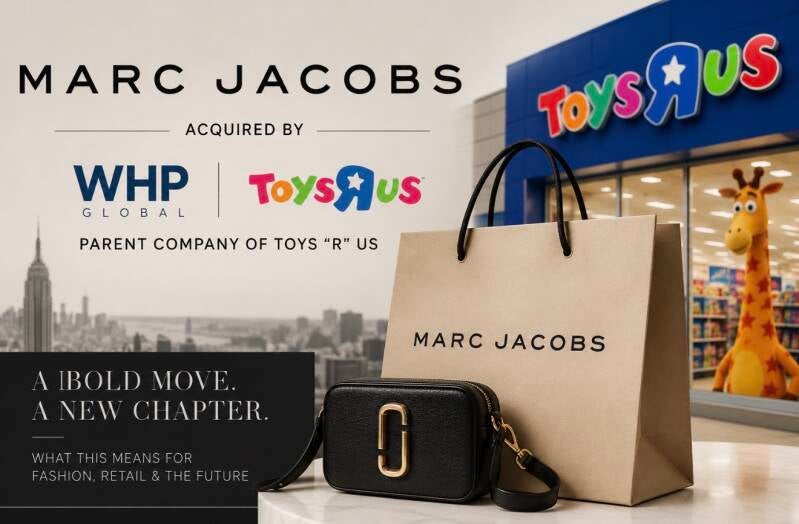
Luxury fashion and mass-market retail rarely occupy the same conversation. That’s what makes the acquisition of Marc Jacobs by WHP Global — the parent company behind Toys “R” Us — such an important retail story to watch.
At first glance, it sounds unexpected. A luxury-adjacent fashion label connected to a company known for reviving legacy retail brands? But the deal says a lot about where the retail industry is heading, especially when it comes to intellectual property, licensing power, and the future value of recognizable brands.
For years, retailers focused heavily on physical store expansion, inventory growth, and direct sales. Now, many companies are realizing that the brand itself may actually be the most valuable asset. A recognizable name with strong cultural awareness can be monetized across licensing deals, collaborations, wholesale partnerships, digital commerce, and international expansion without necessarily owning massive retail footprints.
That is exactly the type of strategy WHP Global has been building. The company has assembled a portfolio of recognizable consumer brands spanning fashion and retail, including names like Express, Vera Wang, and Rag & Bone. Adding Marc Jacobs strengthens its position not just in fashion, but in cultural branding overall.
The more interesting retail angle is what this means operationally.
Modern retail companies are increasingly becoming brand operators rather than traditional retailers. Instead of relying purely on owned stores, companies are focusing on licensing ecosystems, strategic partnerships, ecommerce distribution, and selective physical retail experiences. The goal is no longer simply “sell more products.” The goal is to maximize the value of the brand across multiple revenue channels.
That model changes how merchandising, store layouts, inventory planning, and customer engagement work.
When a company operates through licensing and partnerships, consistency becomes critical. The in-store experience, product presentation, visual merchandising, and customer perception all need to align with the brand identity regardless of who is operating the store or fulfillment channel. That creates larger importance around executional standards and retail presentation strategy.
This is especially important for a brand like Marc Jacobs because its value has always extended beyond the product itself. The brand has cultural recognition tied to fashion identity, runway influence, collaborations, and trend relevance. Maintaining that perception while expanding accessibility will likely become one of the biggest balancing acts following the acquisition.
There is also another important layer here: the collapse of rigid retail categories.
Years ago, luxury brands stayed in one lane, toy retailers stayed in another, and department stores operated separately from entertainment-driven commerce. Today, those lines are disappearing. Retail is becoming more ecosystem-driven. Companies want portfolios of brands that can generate attention, licensing opportunities, and consumer engagement across multiple categories simultaneously.
That explains why a company associated with Toys “R” Us can now own a globally recognized fashion label without it feeling completely out of place in modern retail strategy.
The acquisition also reflects a broader reality inside the luxury sector. Large luxury conglomerates like LVMH are increasingly concentrating resources around their biggest-performing brands. Smaller brands with strong recognition but different growth trajectories are becoming candidates for sale, restructuring, or licensing-focused ownership models.
For retailers and merchandising professionals, this deal reinforces an important lesson: brand perception is becoming just as important as physical retail infrastructure.
A recognizable brand with strong consumer awareness can still create enormous value even in a volatile retail environment. But sustaining that value depends heavily on execution. Poor store presentation, inconsistent merchandising, disconnected inventory strategy, or weak customer experience can damage the perception that companies are paying billions to acquire.
Retail companies are no longer just buying products or stores. They are buying cultural relevance, customer recognition, and long-term brand equity. And in today’s retail environment, that may be the most valuable inventory of all.
Add comment
Comments