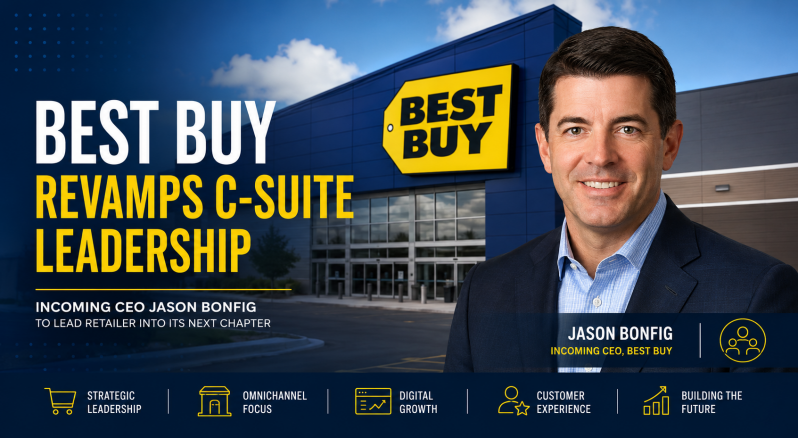
Leadership transitions are among the most important moments in retail. While new products, store remodels, and promotional events often receive the spotlight, the people making strategic decisions behind the scenes ultimately determine a retailer’s long-term direction. Best Buy’s latest executive restructuring is a perfect example of this.
As Jason Bonfig prepares to officially succeed Corie Barry as CEO later this year, Best Buy has announced a broader reorganization of its executive leadership team, promoting several long-tenured leaders into key C-suite roles. Rather than bringing in outside executives with radically different ideas, the company is doubling down on institutional knowledge while positioning itself for its next phase of growth. (Retail Dive)
At first glance, these announcements may appear to be routine executive promotions. In reality, they reveal a carefully planned succession strategy that says a great deal about where Best Buy believes the consumer electronics industry is heading.
Jason Bonfig is far from an unknown quantity. Having spent decades at Best Buy, he has led merchandising, customer experience, fulfillment, e-commerce, Best Buy Canada, and the company’s growing retail media business. He also played a major role in launching Best Buy’s third-party online marketplace—an initiative designed to expand product assortment without significantly increasing inventory risk. (Reuters)
That background matters because today’s electronics retail environment looks very different than it did even five years ago.
Consumers are replacing devices less frequently. Inflation has forced households to prioritize essential purchases over discretionary technology upgrades. Online competitors continue to pressure pricing, while manufacturers increasingly sell directly to consumers. At the same time, retailers are discovering that profitable growth often comes from services, memberships, advertising platforms, marketplaces, and customer ecosystems rather than simply selling more products.
Bonfig’s experience aligns almost perfectly with these changing priorities.
Instead of being known solely as a merchandising executive, his portfolio has combined customer experience, digital commerce, fulfillment, and advertising—areas that increasingly drive profitability across modern retail.
The accompanying C-suite restructuring reinforces that strategy. By elevating experienced internal leaders and having them report directly to the incoming CEO, Best Buy is creating an executive team designed around speed, collaboration, and operational execution rather than maintaining traditional organizational silos. (Retail Dive)
One of the biggest takeaways from this announcement is Best Buy’s preference for continuity over disruption.
Many companies experiencing leadership changes choose outside CEOs who promise dramatic transformations. While that approach can inject fresh ideas, it also carries significant operational risk, particularly during uncertain economic conditions.
Best Buy has instead chosen stability.
Its leadership team already understands supplier relationships, inventory management, seasonal demand patterns, omnichannel fulfillment, and the complexities of consumer electronics retail. That existing knowledge reduces the learning curve and allows executives to focus immediately on execution rather than organizational restructuring.
This decision also reflects confidence in the strategic direction established under Corie Barry.
Barry guided Best Buy through one of the most volatile periods in modern retail history, including the unprecedented demand surge during the pandemic followed by several years of slowing electronics sales. While growth eventually moderated as replacement cycles lengthened, the company invested heavily in digital capabilities, memberships, fulfillment, healthcare initiatives, advertising, and omnichannel services that continue to shape its future. (Reuters)
Bonfig now inherits both the opportunities and challenges created by that transformation.
Perhaps the most interesting aspect of this transition is what it suggests about the future definition of a successful electronics retailer.
Historically, retailers competed primarily on product selection, pricing, and store footprint.
Today, competitive advantage increasingly comes from ecosystem development.
Retailers want customers who subscribe to memberships, finance purchases, buy protection plans, use installation services, trade in devices, purchase through marketplaces, and engage with personalized advertising experiences. Every interaction strengthens customer loyalty while generating higher-margin revenue streams than hardware sales alone.
This mirrors strategies successfully employed by companies such as Amazon and Walmart, where advertising businesses, memberships, fulfillment services, and marketplaces have become major profit drivers alongside traditional retail operations.
Best Buy appears to be following a similar path—but tailored to consumer electronics.
Another implication concerns physical stores.
Some observers assume leadership changes automatically signal widespread store closures or dramatic redesigns. However, Best Buy’s recent strategic investments suggest something different.
Stores are increasingly becoming fulfillment hubs, service centers, consultation spaces, installation support locations, and pickup destinations rather than simply places to purchase televisions or laptops.
That evolution requires tighter coordination between merchandising, supply chain, digital technology, customer service, and marketing—precisely the areas represented in Bonfig’s leadership background.
For retail professionals, there is an important lesson here that extends beyond Best Buy.
Retail success today depends less on individual departments performing well in isolation and more on cross-functional integration. Merchandising decisions influence inventory planning. Digital experiences affect in-store traffic. Marketing impacts fulfillment capacity. Customer service drives repeat purchases. The retailers that align these functions effectively will generally outperform those that continue operating in organizational silos.
Best Buy’s executive realignment appears designed around that philosophy.
Whether this leadership transition ultimately delivers stronger financial performance remains to be seen. Consumer electronics remains one of retail’s most competitive categories, and macroeconomic pressures continue to influence discretionary spending. However, Best Buy’s decision to promote experienced internal leaders rather than pursue an external overhaul suggests confidence in its existing strategy while recognizing that execution—not reinvention—may be the company’s greatest opportunity over the next several years.
Leadership changes are often viewed as endings.
In Best Buy’s case, this appears less like closing one chapter and more like accelerating an existing transformation. The company isn’t abandoning the strategy that carried it through the past several years—it is building a leadership team specifically designed to execute that strategy faster, more cohesively, and with a sharper focus on the omnichannel future of retail.
Add comment
Comments