
Most retail displays are built around one simple idea: make the product visible.
Shelves get filled. Signage gets printed. Promotions get placed near the front. From the outside, everything appears organized and intentional.
But here’s the uncomfortable truth most retailers eventually discover.
Visibility does not equal conversion.
A display can be perfectly stocked, beautifully arranged, and located in what seems like a logical spot in the store—and still barely move product.
The reason for this is simple but rarely discussed.
Retail displays don’t succeed because they look good.
They succeed because they align with human behavior.
Behind every high-performing retail display is a set of invisible forces shaping how customers move, where they pause, and what captures their attention. When those forces are understood and used intentionally, displays convert. When they’re ignored, even the best products can sit untouched.
Understanding the hidden science behind retail displays is what separates stores that merely organize merchandise from stores that consistently drive sales.
Retail Displays Are Actually Behavioral Triggers
Customers rarely enter a store with the intention of carefully analyzing every product they encounter.
Instead, shopping behavior is fast, selective, and heavily guided by subconscious cues.
Within the first few seconds of entering a retail environment, the brain begins filtering information. Lighting, color contrast, product grouping, signage hierarchy, and spatial positioning all influence where the eyes move first.
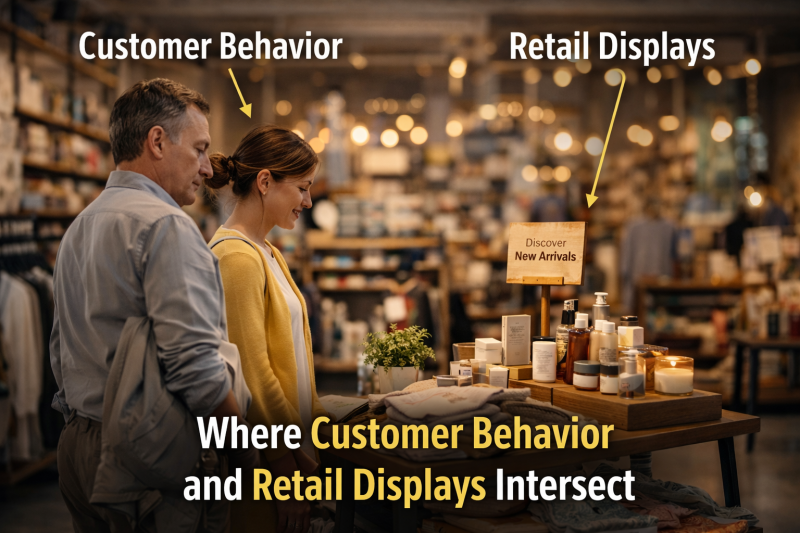
This process happens quickly and automatically.
If a display fails to interrupt this automatic scanning process, the customer’s brain simply moves past it.
High-converting retail displays are designed specifically to interrupt that pattern.
They create what behavioral scientists call a visual interruption—a moment where something stands out enough to cause the shopper to pause, even briefly.
That pause is everything.
Because once a shopper slows down, even slightly, the probability of engagement rises dramatically.
The difference between a product that sells and one that doesn’t often comes down to this moment of interruption.
The Power of the “Lead Story”
One of the most overlooked elements in retail display design is what visual merchandisers refer to as the lead story.
A lead story is the first visual narrative a shopper encounters when approaching a display. It tells the brain what the display is about before the customer consciously processes the products.
When displays lack a clear lead story, shoppers experience what psychologists call cognitive friction.
Their brain must work harder to interpret what they are seeing.
Most customers simply don’t bother.
Instead, they move on.
High-converting displays reduce cognitive friction by presenting a clear visual anchor. This might be a hero product positioned at eye level, a strong graphic that frames the display, or a single color theme that creates visual unity.
The lead story acts as the entry point to the display.
Once the brain understands the story, the shopper becomes more willing to explore the rest of the products around it.
Why Positioning Matters More Than Design
Many retailers focus heavily on the aesthetics of their displays but overlook the single most important factor influencing display performance: placement.
The location of a display within the store determines how many customers will actually encounter it in a meaningful way.
Retail environments naturally create what are known as hot zones and cold zones.
Hot zones are areas where customer attention naturally concentrates. These locations typically include entry decompression zones, aisle intersections, endcaps, and areas where customers must slow down or change direction.
Cold zones, on the other hand, are areas that shoppers tend to pass quickly or ignore entirely.
Even a well-designed display placed in a cold zone will struggle to convert.
Conversely, a moderately designed display placed in a strong hot zone often performs significantly better.
This is why effective retail merchandising is as much about spatial strategy as it is about visual design.
The display itself is only part of the equation.
Where it sits in the customer journey matters just as much.
The Role of Visual Hierarchy
Another hidden factor behind successful retail displays is visual hierarchy.
When shoppers approach a display, their eyes do not absorb everything at once. Instead, the brain processes information in layers.
First, it notices the largest or highest-contrast element.
Then it moves to the secondary elements surrounding it.
Finally, it begins scanning individual products.
Displays that convert well guide this process intentionally.
They use size, contrast, lighting, and product placement to direct the shopper’s gaze through the display in a deliberate order.
Without this structure, displays become visually noisy.
Too many competing elements create confusion, and confusion leads to disengagement.
High-performing retail displays simplify the visual message.
They give the shopper’s eyes a clear path to follow.
Why Simplicity Often Converts Better
A common mistake retailers make when designing displays is trying to showcase too many products at once.
The thinking seems logical.
More products should mean more opportunities for customers to buy.
But in reality, the opposite often happens.
When customers are presented with too many options at once, decision-making slows down. The brain must process more information, which increases cognitive load.
As cognitive load increases, the likelihood of purchase decreases.
This phenomenon, often referred to as the paradox of choice, is one reason why many high-performing displays focus on fewer products.
By simplifying the visual field, retailers make it easier for customers to make quick decisions.
Clarity drives action.
The Importance of Stop Zones
One of the most critical elements in retail display strategy is something most stores never intentionally design.
Stop zones.
Stop zones are areas within a store where customer movement naturally slows down. These zones are often created by environmental conditions such as narrow aisle transitions, turns in traffic flow, queue lines, or visual bottlenecks.
When displays are positioned inside or immediately adjacent to these zones, they benefit from increased customer attention.
The shopper’s pace slows.
Their eyes begin scanning the surrounding environment.
Displays positioned in these moments have a far greater chance of capturing attention.
Many retailers accidentally place their most important displays in areas where customers are still moving quickly, dramatically reducing their impact.
Understanding stop zones can transform how a store performs without changing a single product.
Retail Displays Are About Controlling Attention
At its core, retail display strategy is not really about decoration.
It is about attention control.
Every store competes for the limited attention of the shopper walking through the environment.
Displays that convert are not simply attractive.
They are intentional.
They interrupt scanning patterns, reduce cognitive friction, guide visual hierarchy, and position products in areas where customer attention naturally concentrates.
When these factors work together, displays stop being passive shelving.
They become silent sales tools.
The Difference Between a Display That Looks Good and One That Sells
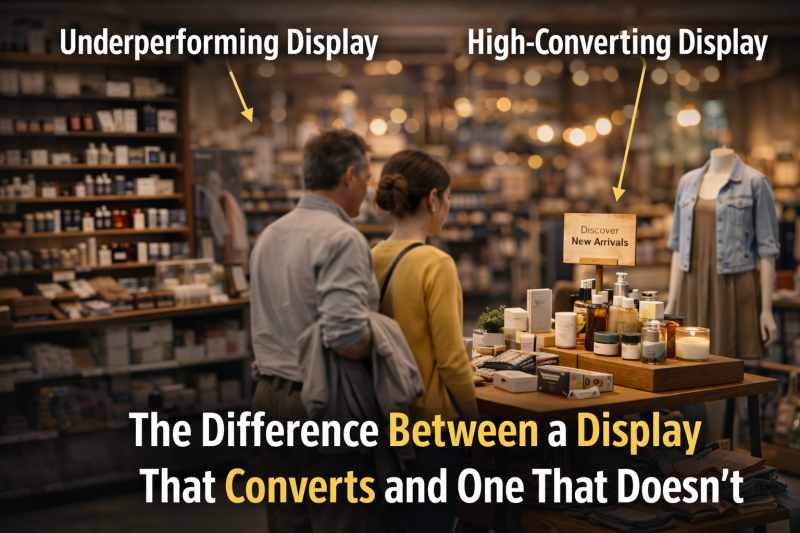
Retailers often judge displays by how polished they appear.
But visual appeal alone rarely drives performance.
The highest-converting displays are those built with an understanding of customer behavior, spatial psychology, and visual hierarchy.
They are designed not just to be seen, but to influence how customers move, pause, and decide.
Once retailers begin designing displays with these principles in mind, the difference becomes noticeable.
Products that previously blended into the background start gaining attention.
Customers spend more time engaging with key items.
And most importantly, displays begin doing what they were always meant to do.
Convert.
Want to Improve How Your Retail Displays Perform?
Many retailers assume their displays are underperforming because of the product, the pricing, or the promotion.
But in many cases, the real issue is how the display interacts with customer behavior inside the store.
Small adjustments in placement, visual hierarchy, and traffic flow can dramatically change how customers engage with merchandise. When displays are designed intentionally around shopper behavior, they stop being passive shelving and start becoming active sales tools.
If you’re launching a store, running a pop-up, redesigning a retail space, or trying to improve in-store conversion, a strategic display and layout review can uncover opportunities most retailers overlook.
You can learn more about my retail display and merchandising consulting services here:
👉https://www.fiverr.com/s/WEWXqLB
About the Author
Christian DiBuono is a retail merchandising consultant specializing in store layout strategy, planograms, and retail display optimization. His work focuses on helping retailers design store environments that improve product visibility, customer engagement, and in-store conversion.
Add comment
Comments