
Target is investing roughly $2 billion into store remodels, layout improvements, and technology upgrades as part of a broader effort to strengthen the in-store shopping experience.
A Major Bet on the Future of Physical Retail
Target Corporation has spent decades positioning itself as one of America’s most recognizable retail brands. Known for blending affordability with a slightly more curated shopping experience than traditional discount retailers, Target has long relied on strong store environments, compelling merchandising, and thoughtful product presentation to stand apart from competitors. But in 2026, the company is facing a different retail landscape than the one that helped build its success.
After a challenging year marked by slowing sales and shifting consumer behavior, Target has announced plans to invest approximately $2 billion into its stores and operations. The initiative focuses on remodeling existing locations, improving store layouts, upgrading technology systems, and strengthening the overall in-store experience.
At first glance, this may sound like a typical retail refresh. Large chains remodel stores all the time. But the scale of the investment and the strategic language behind it suggest something deeper. Target is not simply repainting walls or replacing fixtures. The company is attempting to rethink how its stores function and how customers interact with them.
The decision reflects a growing understanding across the retail industry: the physical store is still one of the most powerful tools a retailer has.
Why Target Is Reinventing Its Stores
Over the past several years, retailers have faced a complicated economic environment. Inflation has made shoppers more cautious with spending, while online marketplaces continue to reshape how consumers research and buy products. At the same time, discount competitors and fast-moving e-commerce platforms have intensified pressure on traditional retail models.
For Target, the challenge is particularly complex. The company built its brand around a specific promise: offering stylish, well-designed products at affordable prices in stores that feel organized, modern, and easy to shop. When economic pressure pushes consumers toward either extreme value or premium experiences, that middle ground becomes harder to maintain.
Recent results have reflected those pressures. Leadership has acknowledged that the past year has been difficult, with changing consumer spending patterns affecting sales performance. Rather than relying on small adjustments, Target is choosing a much larger response—investing heavily in its stores to strengthen the customer experience and improve operational efficiency.
This investment will focus on store remodels, new store openings, enhanced merchandising strategies, and improved technology systems designed to help teams respond more quickly to demand and trends.

Strategic store layouts, product zoning, and seasonal displays can influence how customers move through a retail environment and what they ultimately purchase.
The Strategy Behind the $2 Billion Investment
What makes this investment particularly interesting is how it addresses the role of physical stores in modern retail.
For years, industry discussions focused heavily on the growth of e-commerce and the supposed decline of brick-and-mortar shopping. Yet many of the largest investments in retail today are going back into stores. Companies increasingly recognize that physical locations serve multiple roles at once: they are shopping environments, fulfillment hubs for online orders, brand showcases, and marketing platforms.
Target’s strategy reflects this shift.
Remodeling stores allows the company to rethink how customers move through the space, which categories receive the most visibility, and how products are grouped together. Small changes in layout can dramatically influence shopper behavior. A well-placed seasonal display can increase impulse purchases. A clearer aisle structure can help customers navigate faster. Strategic product adjacencies can encourage complementary purchases.
Technology will also play a major role in the transformation. Target plans to expand its use of data tools and artificial intelligence to improve demand forecasting, product assortment decisions, and merchandising placement. These tools allow merchants to react more quickly to changing trends and ensure that stores reflect what customers are actually looking for.
The result is a store environment that is not only more attractive but also more responsive to customer behavior.
A Renewed Focus on the Core Customer
Another key element of Target’s strategy is a renewed emphasis on serving what the company describes as its core audience: busy families.
This focus may sound simple, but it has major implications for how stores are designed. Families often shop with efficiency in mind. They want stores that are easy to navigate, clearly organized, and structured in ways that reduce friction during the shopping trip.
If a shopper can quickly locate essentials, discover useful products nearby, and complete their purchase without confusion or frustration, the experience becomes both faster and more satisfying.
Designing stores around that kind of behavior requires careful planning. Categories must be positioned strategically. Traffic flow must guide shoppers naturally through key areas. High-demand products need to be easy to find while still exposing customers to additional items along the way.
When retailers successfully align store design with customer behavior, they often see improvements not just in customer satisfaction but also in sales performance.
What Other Retailers Should Learn From This Move
While few retailers have the ability to spend billions redesigning their store network, the underlying lesson from Target’s strategy applies to businesses of every size.
Store environments should never be treated as static. Many retailers operate with layouts that were established years earlier and rarely updated. Over time, these environments can become inefficient as product assortments change, customer behavior evolves, and new categories emerge.
Target’s investment highlights the importance of viewing the store as a dynamic system rather than a fixed structure.
Retailers should regularly analyze how customers move through their space, where they naturally stop, which areas receive the most attention, and which sections are frequently overlooked. Sometimes the most meaningful improvements come from relatively small adjustments: repositioning displays, improving sightlines, reorganizing product adjacencies, or simplifying navigation.
When these changes are made intentionally, the store begins to guide customer behavior rather than simply reacting to it.
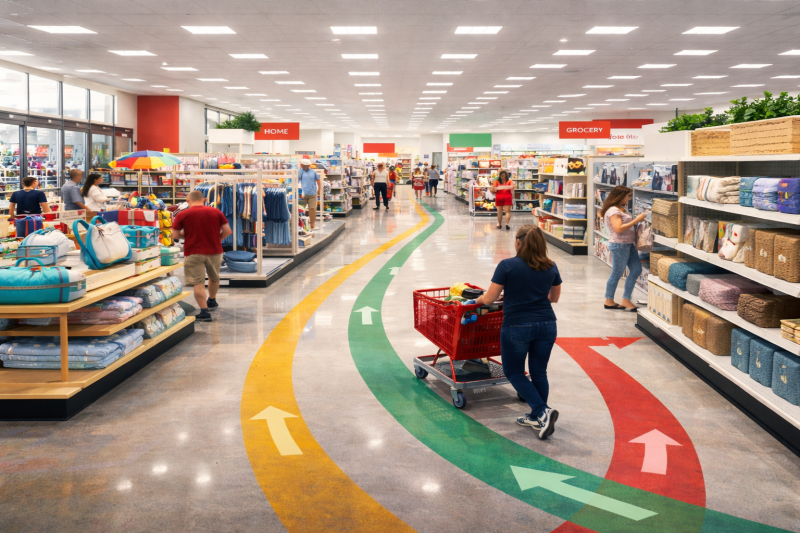
Guiding customer traffic through thoughtful aisle design and merchandising placement can increase product discovery and improve overall store performance.
What This Means for the Future of Retail
Target’s $2 billion investment ultimately represents more than a response to a challenging year. It signals confidence in the long-term importance of physical retail environments.
Even in a digital-first era, stores remain one of the most powerful ways for brands to connect with customers. They offer immediacy, sensory engagement, and discovery in ways that online shopping cannot fully replicate.
The retailers that thrive in the coming years will likely be those that treat store environments as strategic assets rather than operational necessities. Layout, merchandising, and customer flow will continue to play critical roles in determining which stores simply look organized and which ones consistently drive sales.
Target is making a large bet that improving these elements will help restore momentum.
If the strategy succeeds, it may reinforce an important industry truth: the future of retail will not be defined solely by technology or price competition, but by how effectively retailers design physical environments that turn attention into purchases.
Final Thoughts
Target’s $2 billion investment sends a clear message to the retail industry: the physical store is still one of the most powerful tools a brand has. When store environments are designed intentionally — with customer behavior, traffic flow, and merchandising strategy in mind — they become more than just places where products sit on shelves. They become environments that guide shoppers, influence decisions, and ultimately drive sales.
For retailers of all sizes, the lesson isn’t about spending billions. It’s about understanding that store layouts, product positioning, and visual storytelling directly shape how customers experience a space. Even small changes to layout, display strategy, and product zoning can significantly improve how a store performs.
Retail environments are never static. The most successful retailers are the ones that continuously refine how their stores work.
Need Help Optimizing Your Store Layout?
If you’re planning a new store, redesigning your layout, or trying to improve in-store conversion, strategic merchandising and layout planning can make a measurable difference.
I help retailers analyze customer flow, optimize product placement, and design store layouts that encourage discovery and increase sales.
Explore retail layout tools and templates:
https://payhip.com/ChristianDiBuonoRetailMerchandisingConsultant
Or learn more about my retail consulting services:
https://www.fiverr.com/s/kLYWYAA
About the Author
Christian DiBuono is a retail merchandising consultant specializing in store layout strategy, planogram development, and customer flow optimization. He works with retailers to improve in-store experiences, increase conversion, and design environments that guide customer behavior.
Add comment
Comments