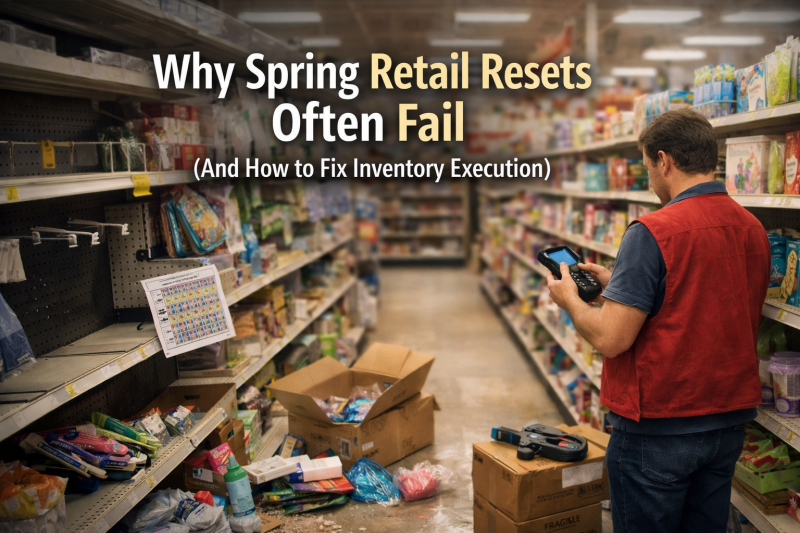
Every spring, retailers across the country begin one of the most important operational events of the year: the seasonal reset. Shelves are reorganized, planograms are updated, new SKUs are introduced, and merchandising strategies shift to match seasonal demand.
In theory, spring resets should refresh stores and improve sales performance.
In reality, many resets fail within weeks of execution.
The issue usually isn’t the strategy. It’s the inventory execution.
The Reset Looks Perfect on Paper
Corporate merchandising teams spend months preparing spring resets. Category managers analyze product performance, vendors negotiate shelf space, and planograms are built to optimize visibility and category flow.
The strategy often makes sense.
High-margin products are placed in better positions. Seasonal merchandise receives stronger visibility. Underperforming items are removed to make room for new inventory.
But the moment the reset reaches the sales floor, problems start to appear.
Planograms assume that the right inventory is available at the right time. Unfortunately, that assumption is rarely true.
Inventory Misalignment Begins Immediately
One of the most common reasons resets fail is simple inventory misalignment.
Stores frequently receive new reset instructions before the necessary products arrive. Merchandisers are then forced to improvise, filling empty shelf space with whatever inventory happens to be available.
This creates a cascade of problems.
Products appear in the wrong locations, facings are incorrect, and the shelf no longer matches the intended merchandising strategy. Within days, the reset already looks different from the planogram that was designed.
Customers notice this immediately.
Instead of seeing a clear and organized assortment, they see gaps, inconsistent product groupings, and shelves that feel unfinished.
Planograms Break Under Real Store Conditions
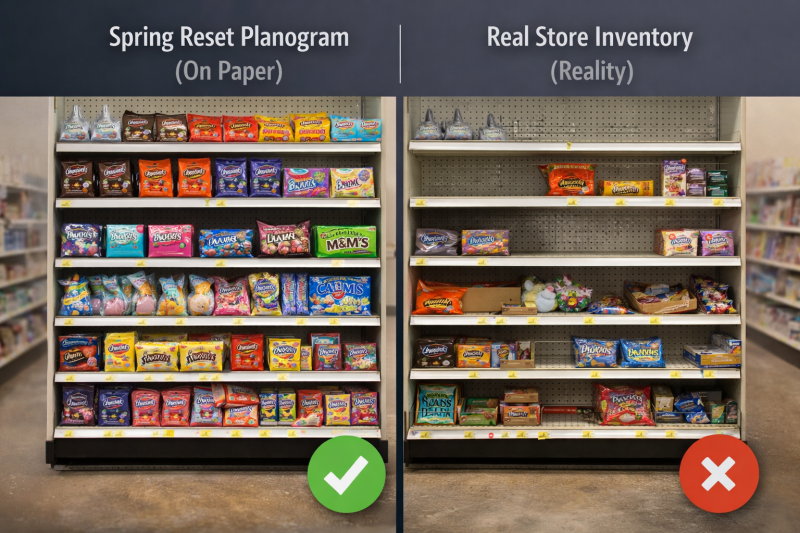
Another reason resets struggle is that planograms are often designed without considering real store conditions.
Shelf capacity may be overestimated. Backroom inventory levels may be inaccurate. In some cases, stores simply do not have enough product to support the number of facings required by the reset.
When this happens, merchandisers are forced to compress facings or substitute items.
The shelf might technically match the planogram layout, but the execution becomes unstable. As soon as products sell through, empty space appears and the reset begins to deteriorate.
This is where many retailers misinterpret the problem.
They blame store execution when the real issue is inventory alignment.
Store Teams Are Rarely Given the Right Guidance
Even when inventory is available, execution can fail because store teams are not given clear operational guidance.
Merchandisers are often instructed to complete resets quickly, sometimes across dozens of categories in a single shift. When time is limited, the priority becomes finishing the reset rather than maintaining merchandising accuracy.
Important details get lost.
Facings may not match the planogram. Secondary items may be placed in high-visibility zones. Promotional displays may be built incorrectly.
Over time, these small deviations compound and the reset loses its intended structure.
The Hidden Role of Shelf Replenishment
A reset is only the beginning of the merchandising cycle.
What determines whether it succeeds is shelf replenishment.
Many retailers focus heavily on the reset itself but ignore what happens afterward. If replenishment processes are weak, shelves quickly drift away from the planogram structure.
High-velocity products sell out. Slower items remain overstocked. Store associates fill gaps with whatever inventory is available.
Within two weeks, the reset is effectively gone.
Fixing the Inventory Execution Problem
The retailers that execute resets successfully tend to approach them differently.
Instead of focusing only on the visual reset, they focus on inventory readiness and operational discipline.
Inventory allocation must align with planogram requirements before resets begin. Stores need enough product to support the required facings and maintain shelf stability after the reset.
Equally important is providing store teams with clear merchandising priorities.
High-volume products should always maintain full facings. Seasonal items must remain in their designated zones. Replenishment processes should reinforce the structure of the reset rather than undermine it.
When these operational details are aligned, resets remain stable for months instead of weeks.
The Real Goal of a Retail Reset
The purpose of a retail reset isn’t simply to rearrange shelves.
It’s to create a stable merchandising structure that supports customer discovery, product visibility, and consistent replenishment.
That only happens when inventory execution matches merchandising strategy.
Retailers that recognize this shift their focus from designing resets to sustaining them.
And when that happens, the reset stops being a short-term project and becomes a long-term sales driver.
Add comment
Comments