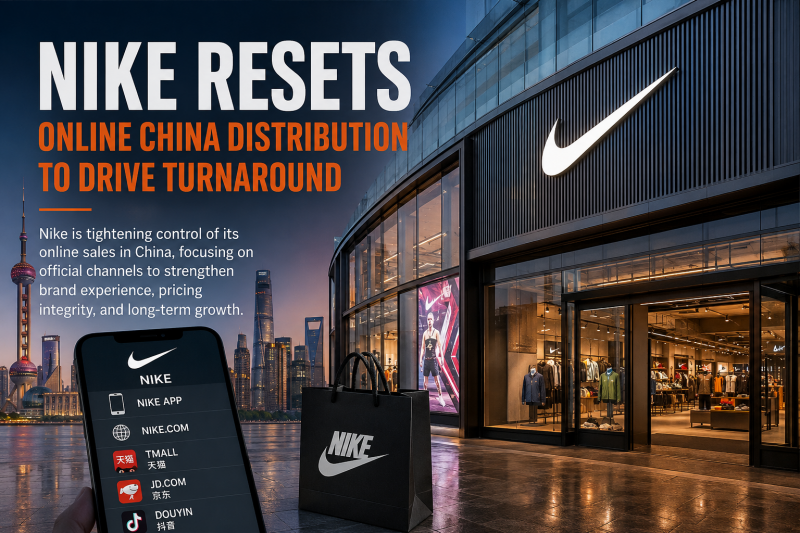
Nike is making one of its boldest strategic moves in years as it attempts to reignite growth in one of its most important international markets. Facing declining sales, intensifying competition, and a rapidly evolving digital retail landscape, the company is fundamentally changing how consumers purchase Nike products online in China. Rather than allowing hundreds of retail partners to sell its products across numerous online storefronts, Nike is consolidating digital distribution around its own official channels and flagship stores on major marketplaces including Tmall, JD.com, Douyin, its website, and its mobile app. The strategy represents a significant shift away from broad marketplace distribution in favor of greater brand control and a more consistent customer experience. (Retail Dive)
The decision comes at a difficult time for Nike. Greater China has become one of the company’s biggest challenges, with revenue continuing to decline as domestic competitors strengthen their positions. The company’s most recent quarter saw sales in the region fall again, highlighting that the turnaround effort remains a work in progress. Chinese consumers have become increasingly selective with discretionary spending amid economic uncertainty, while homegrown athletic brands such as Anta and Li Ning have successfully captured market share by offering products that resonate more closely with local tastes and trends. At the same time, global competitors have continued expanding their presence, creating one of the most competitive athletic footwear markets in the world. (Retail Dive)
Nike believes that part of the problem isn’t simply consumer demand but also the shopping experience itself. The company’s leadership argues that China’s online marketplace has become fragmented, with products appearing across thousands of independent digital storefronts. This can create inconsistent pricing, varying levels of customer service, and a less premium brand experience. By directing shoppers toward official Nike-operated channels, the company hopes to rebuild trust, improve price integrity, and deliver a more seamless connection between its digital and physical retail ecosystem. The strategy also gives Nike significantly greater control over merchandising, inventory allocation, promotional activity, and consumer data. (Retail Dive)
For retail partners, however, the transition will not be painless. Many distributors that previously generated substantial online revenue from Nike products will no longer be permitted to sell them digitally beginning next year. Instead, these partners will focus primarily on operating physical stores. Investors reacted quickly, with shares of major Chinese retail partners falling sharply after the announcement as markets priced in the expected short-term financial impact. While Nike has emphasized that these partners remain critical to its brick-and-mortar strategy, the restructuring represents a meaningful change to the relationship between the brand and its wholesale network. (Reuters)
Not everyone is convinced the strategy will succeed. Several analysts argue that Nike’s biggest challenge isn’t distribution but product relevance. They contend that consumers in China are increasingly choosing domestic brands because those companies design products specifically for local preferences, cultural trends, and sporting habits. Restricting distribution may strengthen brand presentation, but if consumers continue preferring competing products, limiting availability could unintentionally make it easier for rivals to capture even more market share. Some estimates suggest the strategy could cost Nike hundreds of millions of dollars in sales during the transition period if demand does not quickly improve. (Reuters)
Nike appears aware of that criticism. Alongside its digital distribution overhaul, the company has been investing more heavily in locally designed products and recently appointed leadership focused specifically on product creation for the Chinese market. This reflects a broader recognition that success in China increasingly depends on localization rather than simply exporting global product strategies. Consumers are looking for brands that understand regional preferences, shopping behaviors, and cultural trends, making localized innovation just as important as operational efficiency. (Reuters)
From a retail strategy perspective, this move illustrates an important lesson about modern omnichannel commerce. More distribution channels do not always create a better customer experience. While expanding distribution can increase reach, it can also dilute pricing discipline, weaken brand consistency, and create operational complexity. Premium brands often face the difficult balancing act of maximizing accessibility while preserving exclusivity and customer trust. Nike is betting that fewer, better-controlled digital touchpoints will ultimately create stronger long-term loyalty than widespread availability across countless third-party sellers. (Reuters)
Whether this strategy succeeds will likely depend on execution rather than distribution alone. If Nike combines tighter control over its online ecosystem with stronger locally relevant products, improved innovation, and a compelling customer experience, the company could regain momentum in one of the world’s largest athletic markets. However, if consumer preferences continue shifting toward domestic competitors, simplifying online distribution by itself may not be enough to reverse the company’s recent struggles.
Nike’s decision serves as a reminder that retail transformation extends far beyond simply opening more sales channels. In today’s marketplace, controlling the customer journey, maintaining brand consistency, and delivering products that resonate with local consumers are increasingly becoming the true competitive advantages. For retailers everywhere, China’s evolving market continues to demonstrate that sustainable growth depends not only on where products are sold, but on how the entire shopping experience is designed.
Add comment
Comments