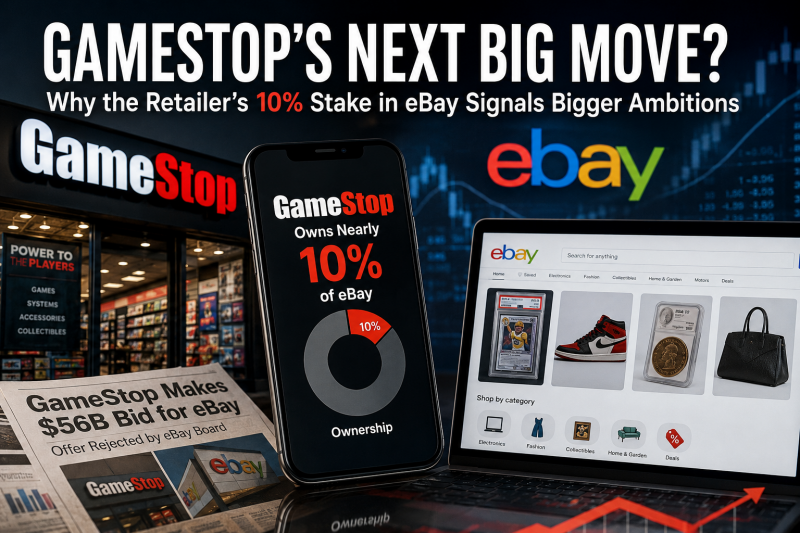
The retail world has seen its fair share of surprising acquisitions, but few have generated as much debate as GameStop’s continued pursuit of eBay. What initially appeared to be an ambitious—and to many, unrealistic—takeover proposal has evolved into something much more strategic. Instead of walking away after eBay rejected its $56 billion acquisition offer earlier this year, GameStop has quietly doubled down by increasing its ownership stake to nearly 10% of the online marketplace.
That move changes the conversation.
When GameStop first announced its intention to acquire eBay, many analysts questioned whether a company with a significantly smaller market capitalization could realistically finance such a transaction. eBay’s board quickly dismissed the unsolicited offer as lacking credibility, and many assumed the story would end there. Instead, GameStop continued accumulating shares, converting derivative positions into common stock and purchasing millions of additional shares, making it one of eBay’s largest shareholders.
From a retail strategy perspective, this is not simply about buying another company. It represents an attempt to redefine what GameStop wants to become over the next decade.
For years, GameStop has worked to distance itself from being viewed solely as a brick-and-mortar video game retailer. The decline of physical game sales has forced the company to diversify into collectibles, trading cards, refurbished electronics, and other higher-margin categories. CEO Ryan Cohen has repeatedly emphasized that GameStop’s future depends less on physical software sales and more on becoming a broader commerce platform capable of competing with much larger retailers.
eBay offers something GameStop lacks: an established global marketplace with millions of active buyers and sellers, sophisticated payment systems, authentication services, logistics partnerships, and an ecosystem that extends far beyond gaming. Combining those capabilities with GameStop’s loyal customer base and growing collectibles business could theoretically create a powerful competitor in categories where authenticity and enthusiast communities matter most.
The collectibles market illustrates this opportunity perfectly. Trading cards, graded collectibles, gaming memorabilia, sneakers, and limited-edition merchandise continue to attract passionate consumers willing to spend premium prices. Both companies already operate in adjacent spaces. eBay has invested heavily in authentication and marketplace trust, while GameStop has expanded aggressively into collectibles that now represent an increasingly meaningful portion of its revenue mix. A combined business could potentially create a vertically integrated ecosystem where discovery, buying, selling, authentication, and fulfillment all happen within one platform.
However, strategic logic does not automatically translate into a successful acquisition.
The largest obstacle remains financing. Acquiring a company several times larger than yourself is extraordinarily difficult under any circumstances. While GameStop has outlined financing plans involving cash, stock, and external lending commitments, many investors remain skeptical about whether such a transaction could ultimately close without significant dilution or regulatory complications. Those concerns were among the reasons eBay’s board rejected the original proposal.
Yet ownership itself creates leverage.
Holding nearly 10% of eBay gives GameStop far greater influence than simply being an interested bidder. Large shareholders can communicate directly with other investors, advocate for strategic changes, and potentially launch activist campaigns if they believe management is underperforming. Ryan Cohen has built a reputation as an activist investor before, and many observers believe accumulating shares may be as important as the original acquisition proposal itself.
For retailers across the industry, this story highlights a broader trend. Competitive advantage is no longer determined solely by physical stores or digital storefronts. Increasingly, success comes from controlling ecosystems that connect customers, marketplaces, fulfillment, payments, loyalty programs, and data. Retailers capable of integrating these components create higher switching costs and deeper customer engagement than businesses focused on one channel alone.
Whether GameStop ultimately succeeds in acquiring eBay is almost secondary to what this pursuit reveals about modern retail strategy. The company is signaling that it no longer views itself as simply a retailer selling products. Instead, it wants to become a commerce platform capable of facilitating transactions across multiple categories and communities.
That ambition is bold, controversial, and undeniably risky. But in today’s retail landscape, where traditional business models continue to evolve under pressure from digital marketplaces and changing consumer behavior, standing still often carries its own risks.
Regardless of the transaction’s outcome, GameStop has already succeeded in forcing investors, competitors, and retail executives to reconsider what the company’s long-term identity might become. The next chapter will depend not only on financing and shareholder support, but also on whether GameStop can convince the broader market that its vision extends beyond nostalgia and into the future of connected commerce.
Add comment
Comments