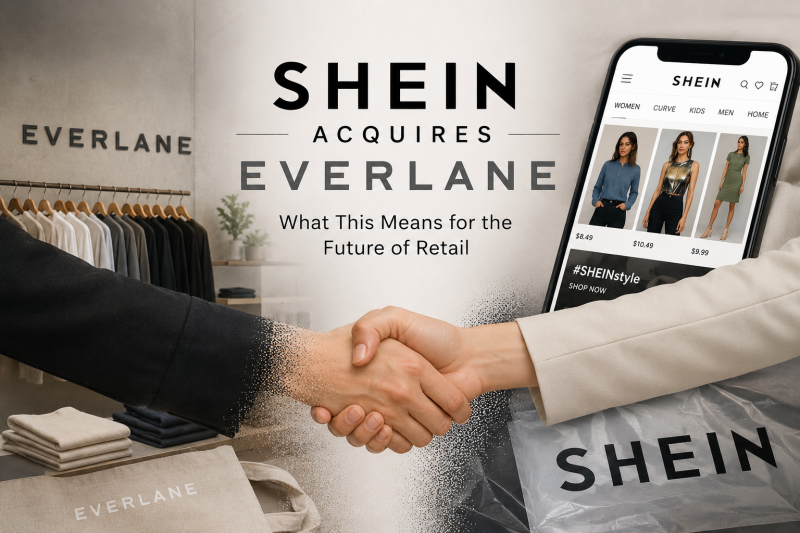
For years, Everlane positioned itself as the anti-fast-fashion brand. The company built its identity around “radical transparency,” ethical sourcing, minimalist design, and a more responsible approach to apparel retail. Shein became the exact opposite symbol in the eyes of many consumers: ultra-fast production cycles, trend-driven inventory, low pricing, and constant criticism surrounding sustainability and labor concerns. That’s why the announcement that Shein is acquiring Everlane feels less like a normal retail acquisition and more like a defining moment for where the industry is headed next.
The reaction online has been intense because the deal represents more than one company buying another. It represents the collision between two completely different retail philosophies. Everlane spent years marketing trust, ethics, and transparency as a competitive advantage. Shein built one of the most aggressive retail supply chain systems in modern commerce by focusing on speed, price accessibility, and rapid trend response. Now those worlds are merging together under one ownership structure.
What makes this situation especially important for retailers is that it exposes a difficult reality about today’s consumer market. Many shoppers say they care about sustainability and ethical production, but affordability and convenience continue to dominate purchasing behavior during periods of economic pressure. Retailers across apparel have struggled to maintain premium ethical positioning while competing against lower-cost, faster-moving operators. The Everlane acquisition may end up becoming one of the clearest examples yet of how difficult it is for “mission-driven” retail brands to survive independently at scale in today’s environment.
From a merchandising and retail operations perspective, the acquisition is also incredibly strategic for Shein. Everlane gives the company something it has historically lacked: a stronger premium lifestyle identity in the Western market. Shein already dominates speed and pricing. What it has struggled with is perception. Acquiring a brand that built years of consumer trust around quality basics and sustainability gives Shein access to an entirely different customer demographic.
This is becoming a larger trend throughout retail. Big operators are no longer just competing for product sales. They are competing for customer identity, brand credibility, and audience segmentation. Retailers increasingly want to own multiple consumer “personas” under one corporate umbrella. One brand targets value shoppers. Another targets premium shoppers. Another targets sustainability-conscious consumers. Even if the backend operations eventually become interconnected, the front-facing brand identity still matters because modern consumers buy into positioning just as much as products.
The deal also highlights how important supply chain efficiency has become in modern retail strategy. Everlane built strong branding, but branding alone no longer guarantees survival. Shein’s infrastructure is arguably the real asset here. The company has mastered data-driven production cycles, fast inventory testing, and demand responsiveness at a scale most retailers still cannot match. Some analysts believe Everlane could benefit operationally from that efficiency if the brand maintains product quality and positioning.
That possibility creates one of the most interesting questions in retail right now: can a company known for hyper-fast fashion successfully operate a brand built on slower, more intentional consumption?
That tension will likely define how consumers react moving forward. Many existing Everlane customers already feel betrayed by the acquisition because the two companies represent opposite values in the public eye. Others may simply care about whether the products remain good and reasonably priced. That divide itself says a lot about where the retail industry currently stands.
For retailers and consultants, there’s another important lesson hidden underneath the headlines. Strong branding and storytelling are no longer enough on their own. Modern retail success increasingly depends on balancing operational efficiency, inventory responsiveness, pricing strategy, customer trust, and brand positioning simultaneously. The companies that survive long term will likely be the ones that can merge emotional branding with highly optimized retail systems behind the scenes.
This acquisition may look shocking today, but it could end up becoming a preview of what retail consolidation looks like over the next decade. Large retail ecosystems are absorbing smaller niche brands not only for revenue, but for customer loyalty, positioning, and market access. In many ways, the future of retail may not belong to companies with one identity. It may belong to companies capable of operating multiple identities at once.
And that may be the biggest takeaway from the Shein-Everlane deal of all. Retail is entering an era where operational scale and brand perception are colliding harder than ever before. The retailers that figure out how to control both will likely dominate the next generation of commerce.
Add comment
Comments